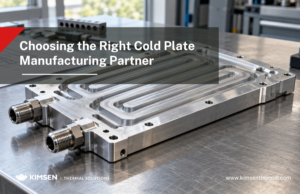
Artificial intelligence is changing more than software. It is also changing the physical design of data centers.
AI training, inference, and high-performance computing place heavy, sustained loads on CPUs, GPUs, memory, and power systems. That computing power eventually becomes heat—and a lot of it. As processors grow more powerful and racks become denser, moving heat away with fans alone becomes harder.
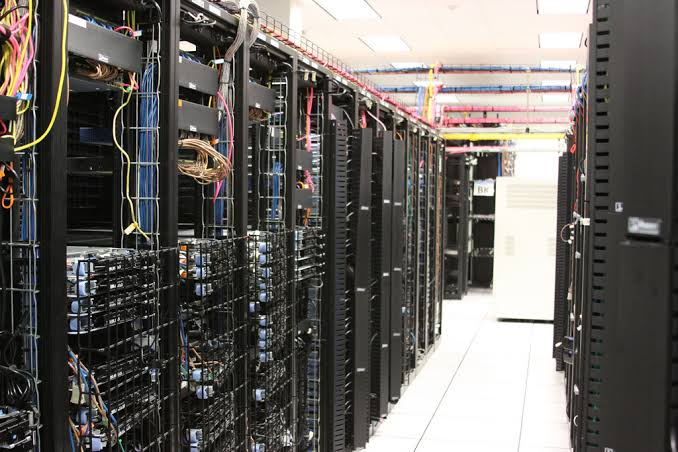
A modern NVIDIA DGX B200 system, for example, has a maximum system power usage of approximately 14.3 kW. Put several high-performance systems in one rack and the thermal challenge rises fast. That is one reason why data center designers are paying closer attention to liquid cooling and immersion cooling.
Both methods use liquid to carry heat away more effectively than conventional air cooling. Still, they are not the same. Their architecture, maintenance needs, component requirements, and suitability for existing facilities differ considerably.
So, which approach makes more sense for an AI data center? Let’s break it down.
Why traditional air cooling is reaching its limits
Air cooling remains common across conventional server rooms. Fans move heated air away from processors, while computer room air-conditioning systems cool and recirculate it.
This arrangement works well for many general computing applications. However, AI servers create concentrated heat loads that challenge traditional airflow management.
The problem is not simply the total amount of heat. It is also where that heat appears. A few high-power GPUs can generate intense thermal hotspots inside a compact server chassis. Increasing fan speed may help, but it also consumes more electricity, creates noise, and still relies on air—a relatively poor heat-transfer medium.
Some facilities use rear-door heat exchangers or combine air cooling with containment systems to handle higher rack densities. Yet, as individual racks move beyond conventional power levels, cooling closer to the heat source becomes more practical.
This is where direct-to-chip liquid cooling enters the picture.
What is direct-to-chip liquid cooling?
Direct-to-chip cooling, also called direct liquid cooling, transfers heat from processors through cold plates mounted directly onto components such as CPUs, GPUs, or accelerators.
Coolant flows through internal channels in each cold plate. As the liquid passes across the heated area, it absorbs energy and carries it toward a coolant distribution unit, or CDU. The CDU then transfers that heat to the facility-side cooling loop.
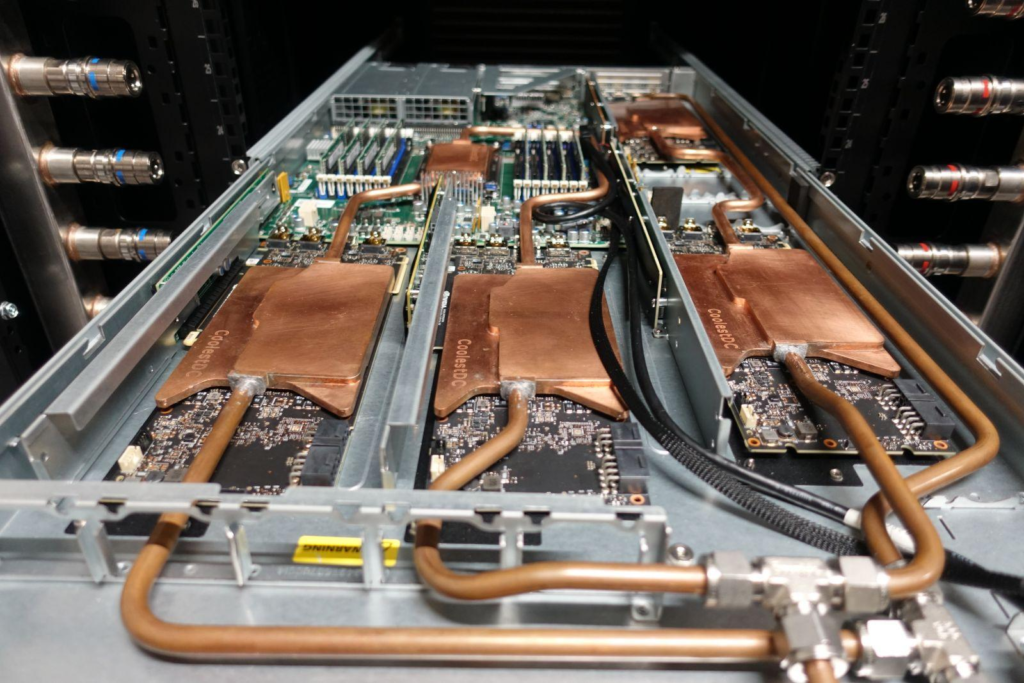
ASHRAE describes a cold plate as a heat exchanger built with internal fins or channels that transfer heat from high-density processors into a circulating cooling liquid. Its effectiveness depends on several connected factors—not only the plate material, but also channel geometry, coolant flow, surface flatness, pressure drop, and the quality of contact with the processor.
A typical direct-to-chip system may include:
- Cold plates for CPUs, GPUs, memory, or power devices
- Tubes, hoses, fittings, and quick-disconnect couplings
- Supply and return manifolds
- Pumps and coolant distribution units
- Heat exchangers and monitoring sensors
- Air cooling for components not connected to the liquid loop
That last point is easy to overlook. Direct-to-chip cooling does not always remove every watt of heat from the server. Storage devices, power supplies, network cards, and other components may still require airflow. Because of this, many AI facilities use a hybrid system combining liquid and air cooling.
What is immersion cooling?
With immersion cooling, server hardware is placed inside a tank filled with an electrically non-conductive, or dielectric, fluid.
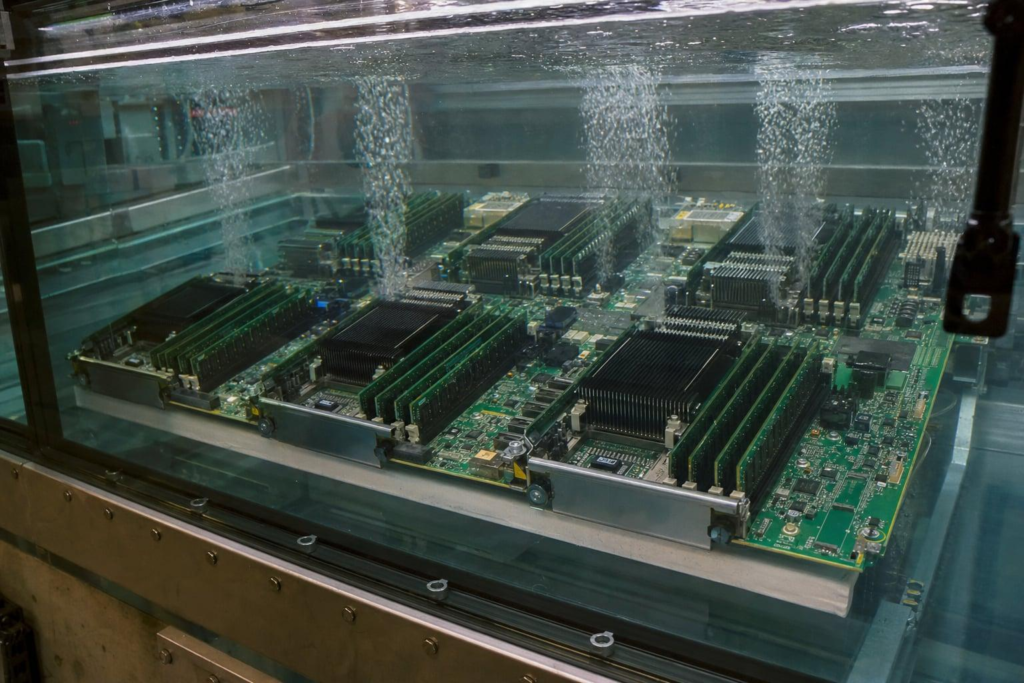
Instead of mounting cold plates on individual processors, the cooling fluid contacts a large portion of the electronic assembly. Heat moves from server components into the surrounding liquid and then passes through the system’s heat-rejection equipment.
There are two main forms of immersion cooling.
Single-phase immersion cooling
The dielectric liquid remains in liquid form as it absorbs heat. Pumps circulate the warmed fluid through a heat exchanger before returning it to the tank.
The architecture is relatively straightforward, although fluid compatibility, filtration, pump selection, and tank design still need careful engineering.
Two-phase immersion cooling
In a two-phase system, the fluid boils when it reaches a defined temperature. The vapor rises, condenses on a cooling coil, and returns to the tank as liquid.
Phase change can transfer large amounts of heat, but the system requires purpose-designed fluids, sealed equipment, and tighter control over operation and maintenance.
Liquid cooling vs. immersion cooling
Both methods address high heat density, yet they follow different engineering paths.
| Comparison area | Direct-to-chip liquid cooling | Immersion cooling |
|---|---|---|
| Cooling method | Coolant passes through cold plates attached to selected processors | Server hardware is submerged in dielectric fluid |
| Main heat-transfer interface | Cold plate and thermal interface material | Direct contact between fluid and electronic hardware |
| Installation | Can be introduced into many rack-based environments | Usually requires immersion tanks and adapted infrastructure |
| Hardware access | Technicians can service rack-mounted equipment in a familiar format | Hardware must be removed from the fluid before some service tasks |
| Remaining air cooling | Often needed for non-liquid-cooled components | Usually reduced significantly |
| Key risks | Leaks, pressure loss, poor contact, clogging, corrosion | Fluid compatibility, contamination, fluid management, service procedures |
| Typical fit | Enterprise AI, HPC clusters, retrofits, mixed-density facilities | Purpose-built high-density deployments and specialized computing environments |
There is no universal winner here.
Direct-to-chip cooling often suits facilities that want to retain familiar rack and server layouts. Immersion cooling can remove heat from a broader area of the electronic assembly, but it may require more changes to hardware, operations, and maintenance routines.
The right choice depends on rack density, server configuration, available facility water, maintenance strategy, deployment scale, and future computing plans.
Why cold plate design matters
In a liquid-cooled server, the cold plate may look like a simple metal block. It is anything but simple.
Heat must first move from the processor through the thermal interface and into the cold plate. The internal channels then need to spread coolant across the active area without creating excessive pressure loss.
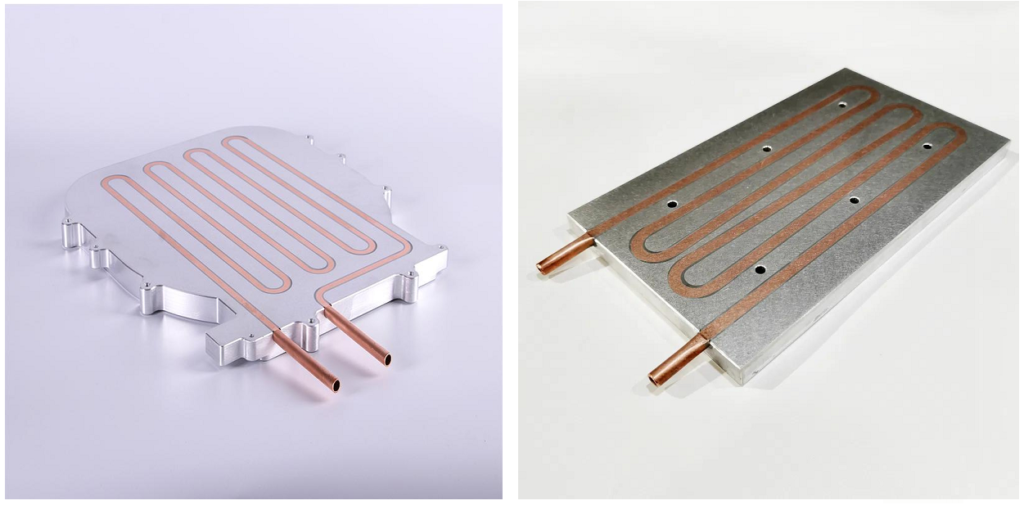
If the plate is not flat enough, thermal contact may become uneven. If the channels are too restrictive, the pump must work harder. If fluid distribution is poor, one part of the processor may run hotter than another.
Several design details deserve attention:
- Channel or fin geometry
- Base thickness and surface flatness
- Coolant flow distribution
- Pressure-drop requirements
- Corrosion resistance
- Material compatibility within the cooling loop
- Joint integrity and leak resistance
- Mounting pressure and dimensional tolerance
- Cleanliness of internal coolant passages
These factors interact. Making a channel smaller may increase heat-transfer performance in one area but can also raise pressure drop. Thinning the cold plate may reduce weight, yet it can make machining and flatness control more demanding.
In other words, thermal design and manufacturing design cannot live in separate rooms. They need to meet early.
The role of aluminum in AI server cooling
Aluminum is widely considered for heat sinks, cold plate housings, manifolds, enclosures, and other thermal-management components because it combines relatively low weight, machinability, corrosion resistance, and useful thermal conductivity.
Extrusion can form consistent channels, fins, mounting features, and structural sections. CNC machining then creates connection ports, sealing surfaces, precision holes, and detailed flow paths. Depending on the cold plate design, manufacturers may also use embedded tubing, friction stir welding, vacuum brazing, or other joining methods.
Material choice alone, however, does not decide the final performance. A well-designed aluminum part with controlled flow channels and reliable joints may perform better than a poorly manufactured component made from a material with higher theoretical conductivity.
Buyers should therefore review the full manufacturing route:
- Material and alloy selection
- Extrusion or preliminary forming
- CNC machining
- Joining and sealing
- Surface treatment
- Cleaning and assembly
- Leak and pressure testing
- Thermal performance testing
Traceability also matters. For data center projects, a small process inconsistency can be repeated across hundreds or thousands of cooling components. Clear inspection records, controlled manufacturing parameters, and early sample validation help limit that risk.
What OEMs should ask a cold plate manufacturer
Thermal performance is essential, but it is only one part of supplier evaluation.
Before sending an RFQ, buyers should define operating conditions as clearly as possible. That includes heat load, coolant type, inlet temperature, target flow rate, maximum pressure drop, working pressure, allowable leakage, surface-flatness requirements, and expected production volume.
It is also worth asking:
- Can the supplier review the design for manufacturability?
- Which processes are performed in-house?
- How are internal channels cleaned after machining or joining?
- What leak-testing method and test pressure will be used?
- Can the supplier measure thermal resistance or pressure drop?
- How are critical dimensions and sealing surfaces inspected?
- Can the process move from prototype to repeat production without changing key characteristics?
These questions may feel detailed at the sourcing stage. Still, they are far cheaper to answer before tooling and validation than after a coolant loop has been assembled.
The future is likely to be hybrid
Air cooling will not disappear overnight. Neither will one liquid-cooling architecture replace every other method.
Many data centers will operate with mixed environments: conventional air-cooled servers in one area, direct-to-chip GPU racks in another, and perhaps immersion systems for specialized workloads. Vertiv notes that direct-to-chip systems are already being used alongside air cooling because not every component inside a server connects to the liquid circuit.
For hardware companies, this creates a practical challenge. Thermal components must offer high performance, but they must also be manufacturable, testable, serviceable, and repeatable at production scale.
That is where close cooperation between thermal engineers, mechanical designers, and manufacturing partners becomes valuable. The cooling concept may begin in simulation, but its real test comes later—when metal, coolant, pressure, and heat finally meet.
Looking for an aluminum cold plate manufacturing partner?
KIMSEN supports OEMs and thermal-solution companies with aluminum extrusion, precision machining, welding, assembly, and testing for advanced cooling applications.
Send us your drawings, estimated annual volume, coolant conditions, pressure requirements, and thermal targets. Our engineering team can review the manufacturing feasibility of your cold plate or liquid-cooling component before quotation.