Selecting a material for a thermal management component involves more than comparing thermal conductivity values.
A component may need to conduct heat, spread concentrated heat loads, contain coolant, withstand pressure, support electronic assemblies, resist corrosion, and remain stable through repeated thermal cycles. The selected material must also be compatible with the intended manufacturing process, production volume, surface treatment, and assembly method.
Copper provides excellent heat conduction but increases weight and cost. Aluminum offers a practical balance of thermal performance, low density, manufacturability, and commercial availability. Stainless steel transfers heat less effectively but may be more suitable for pressure-containing components or aggressive operating environments.
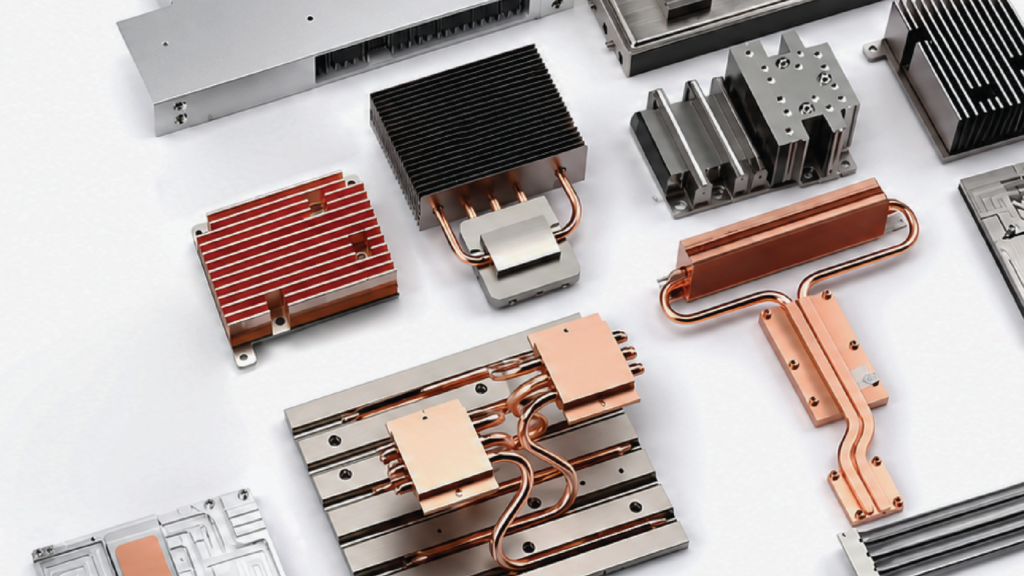
Other metals—including carbon steel, magnesium, titanium, copper-nickel, and nickel-based alloys—may also be appropriate when structural strength, low mass, corrosion resistance, or high-temperature durability becomes the primary requirement.
This article examines how engineers can select mechanical materials for custom heat sinks, cold plates, heat spreaders, manifolds, housings, tubing, brackets, and integrated cooling modules.
Why Material Selection Must Begin with Component Function
There is no universally superior thermal management material. The most appropriate choice depends on the role that the component performs within the complete cooling system.
| Component function | Main material requirement | Typical examples |
|---|---|---|
| Conducting heat | High thermal conductivity and a short heat path | Heat sink base, cold plate wall |
| Spreading heat | Low spreading resistance across a larger area | Copper spreader, vapor chamber shell |
| Rejecting heat | Large surface area, low mass, manufacturable fin geometry | Extruded or skived fins |
| Containing coolant | Corrosion resistance, sealing integrity, pressure capability | Cold plate, manifold, tubing |
| Supporting loads | Strength, stiffness, fatigue resistance | Housing, frame, mounting bracket |
| Protecting electronics | Corrosion resistance, sealing, EMI or grounding performance | Inverter or power electronics enclosure |
| Surviving severe environments | Chemical, marine, or high-temperature resistance | Heat exchanger, coolant pipe, hot-fluid component |
A highly conductive metal may be unnecessary for a structural bracket. Conversely, a strong and corrosion-resistant metal may perform poorly as the main heat-spreading layer. Each material should therefore be evaluated according to the actual heat path and mechanical function.
Key Properties of Thermal Management Materials
Thermal conductivity remains important, but it must be assessed together with density, strength, corrosion resistance, thermal expansion, and manufacturability.
| Selection factor | Engineering significance | Typical trade-off |
|---|---|---|
| Thermal conductivity | Controls heat conduction and temperature distribution inside the component | Higher conductivity can increase weight or cost |
| Density | Affects module mass and mounting loads | Lightweight materials may require additional protection |
| Strength and stiffness | Support pressure, vibration, threads, and mounted components | Higher-strength alloys may offer lower conductivity |
| Corrosion resistance | Influences service life, leakage risk, and coolant cleanliness | Surface protection adds processing requirements |
| Thermal expansion | Affects flatness, seals, joints, and mounted electronics | Dissimilar materials may generate thermal stress |
| Fatigue resistance | Determines durability under vibration and thermal cycling | Strong initial performance does not guarantee long-term reliability |
| Manufacturability | Determines achievable geometry, tolerance, volume, and cost | A suitable material may be difficult to form or join |
| Surface treatment | Provides corrosion protection, insulation, wear resistance, or appearance | Coatings can influence dimensions and contact resistance |
| Material availability | Affects lead time, price stability, and scalability | Specialized alloys may be difficult to source consistently |
| Joining compatibility | Influences weld, braze, solder, and bonded-joint reliability | Poor joints can eliminate the benefit of a conductive material |
The alloy and material condition must also be specified. Two alloys within the same metal family can have substantially different conductivity, strength, corrosion behavior, and processing characteristics.
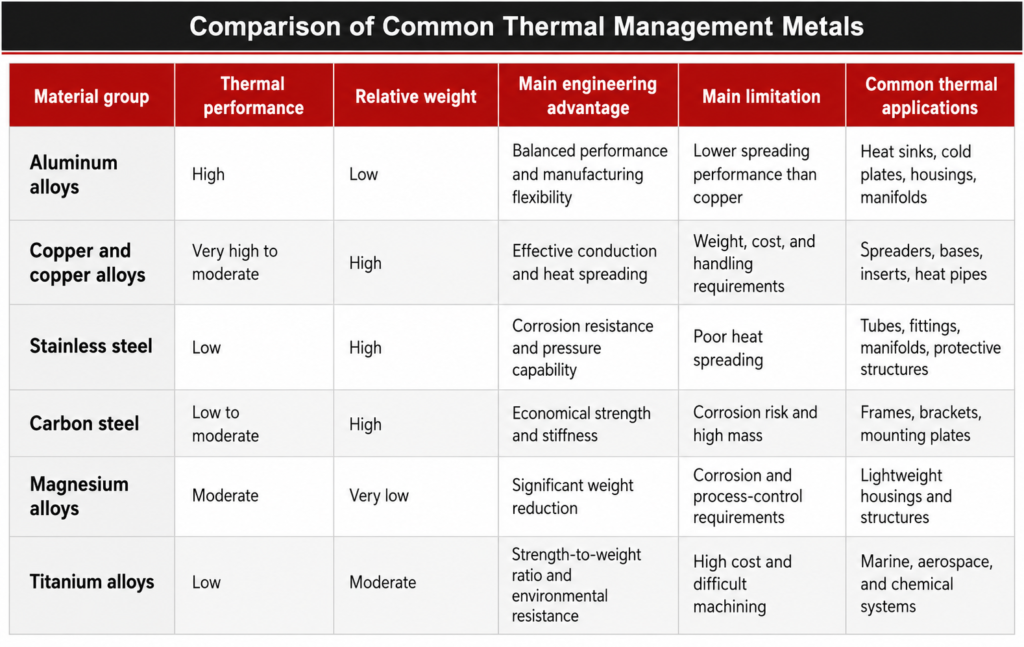
Comparison of Common Thermal Management Metals
The following comparison is qualitative. Actual properties depend on the alloy, temper, product form, manufacturing condition, and operating temperature.
Aluminum Alloys
Aluminum is widely used for thermal management because it combines useful thermal conductivity with low density, corrosion resistance, commercial availability, and broad manufacturing flexibility.
It can be extruded into finned profiles, skived into high-density fin structures, CNC-machined into liquid channels, cast into integrated housings, or formed and brazed into cooling plates. This makes aluminum suitable for both air-cooled and liquid-cooled systems.
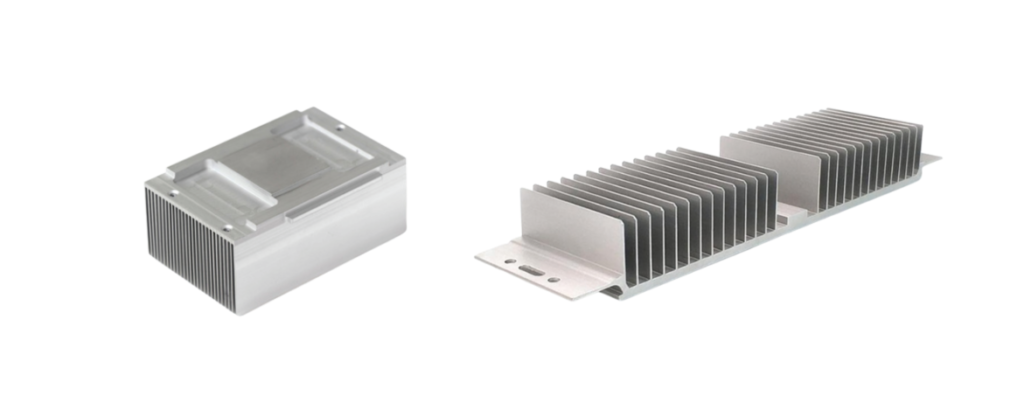
Specifying only “aluminum” is insufficient because different aluminum families serve different functions.
| Aluminum group | Main characteristics | Potential thermal application |
|---|---|---|
| 1xxx series | High aluminum content and relatively high conductivity, but limited structural strength | Fins, conductive plates, specialized heat-transfer parts |
| 3xxx series | Good formability and corrosion resistance | Brazed sheets, fins, heat exchanger components |
| 5xxx series | Good corrosion resistance and weldability | Marine-exposed housings, welded cooling structures |
| 6xxx series | Balanced extrudability, strength, machinability, and finishing capability | Extruded heat sinks, housings, manifolds |
| Machining-grade alloys | Strength and dimensional stability for precision machining | Machined cold plates, bases, structural housings |
| Cast aluminum alloys | Complex shapes and integrated features | Thermal housings, fan bodies, enclosure structures |
Extruded heat sinks commonly use 6xxx-series alloys because these materials support practical fin geometries and stable production. A machined cold plate may require a different alloy to achieve flatness, thread strength, sealing performance, or brazing compatibility.
For cast liquid-cooling components, thermal performance alone is not sufficient. Porosity, sealing surfaces, internal cleanliness, wall thickness, and leakage control must also be addressed.
When Aluminum Is a Strong Candidate
Aluminum is especially suitable when the design requires a large heat-transfer area without excessive mass. It is therefore frequently considered for extruded and skived heat sinks, battery cooling plates, inverter housings, liquid cold plates, manifolds, fan structures, and integrated power electronics enclosures.
Its main limitation appears when heat must spread quickly from a very small, concentrated source. In such cases, a thicker aluminum base, embedded heat pipe, vapor chamber, or copper insert may be required.
Copper and Copper Alloys
Copper is selected when heat conduction and spreading are dominant requirements. It can reduce temperature gradients between a concentrated heat source and a larger heat-transfer surface more effectively than many engineering metals.
This makes copper valuable for heat spreaders, high-heat-flux bases, vapor chambers, heat pipes, cold plates, local inserts, and soldered thermal assemblies.
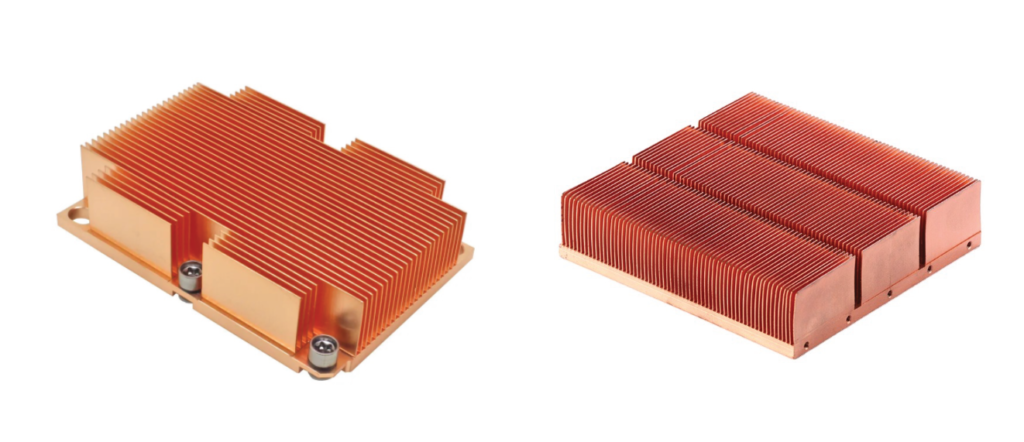
Engineering Trade-Offs of Copper
| Design consideration | Copper performance | Engineering implication |
|---|---|---|
| Heat conduction | Excellent | Suitable for concentrated heat sources |
| Heat spreading | Excellent | Can reduce base temperature gradients |
| Density | High | Adds load to PCBs, frames, and mounting structures |
| Material cost | Generally higher than aluminum | Best used where its thermal benefit is measurable |
| Machining | Feasible but process-dependent | Tooling, chip control, and surface quality require attention |
| Skiving | Suitable | Enables dense, thin-fin structures |
| Soldering and brazing | Generally suitable with the correct process | Useful for heat pipes and multi-part assemblies |
| Corrosion behavior | Depends on environment and alloy | Coolant and dissimilar-metal compatibility must be checked |
A complete copper heat sink is not always the most efficient system-level solution. If convection, airflow, coolant flow, or interface resistance dominates the thermal path, replacing aluminum with copper may produce only a limited temperature improvement while substantially increasing weight.
Pure Copper and Copper Alloys
Copper alloys should not be treated as equivalent to high-conductivity copper. Alloying elements can improve strength, machinability, wear resistance, or corrosion performance, but generally reduce thermal conductivity.
The correct material depends on whether the design prioritizes heat spreading, structural strength, joint durability, corrosion resistance, or manufacturing stability.
Material Compatibility with Manufacturing Processes
A suitable material must support both the required geometry and a commercially stable manufacturing process.
| Manufacturing process | Common material candidates | Typical thermal components |
|---|---|---|
| Extrusion | Aluminum; selected magnesium alloys | Heat sinks, housings, manifolds |
| Skiving | Aluminum, copper | High-density fin heat sinks |
| CNC machining | Aluminum, copper, steel, stainless steel, titanium | Cold plates, bases, channels, manifolds |
| Stamping and forming | Aluminum, copper, carbon steel, stainless steel | Fins, covers, brackets, plates |
| Brazing | Aluminum, copper, stainless steel, nickel alloys | Cold plates and heat exchangers |
| Welding | Aluminum, carbon steel, stainless steel, titanium | Housings, manifolds, tanks, frames |
| Soldering | Copper and compatible coated metals | Heat pipes, spreaders, compact assemblies |
| Mechanical assembly | Most metal families | Multi-material modules and replaceable components |
The manufacturing route should be considered early. Fin thickness, channel geometry, wall thickness, flatness, sealing surfaces, joint accessibility, and production volume may eliminate otherwise attractive material candidates.
Hybrid Metal Structures
A thermal component does not always need to be manufactured from a single metal. Hybrid designs can place each material where it delivers the most value.
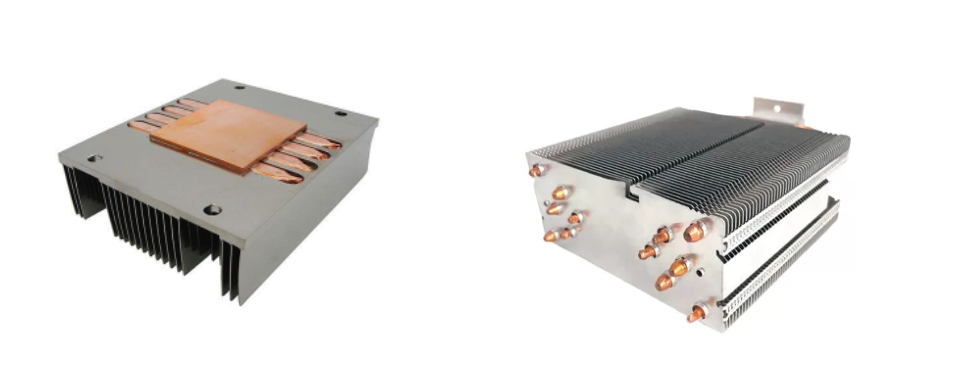
| Hybrid configuration | Intended benefit | Main design concern |
|---|---|---|
| Copper spreader with aluminum fins | High local heat spreading with reduced total mass | Interface resistance and galvanic compatibility |
| Copper base with aluminum fin field | Improved base conduction with lightweight fins | Joint durability |
| Aluminum cold plate with stainless fittings | Conductive plate with durable fluid connections | Galvanic corrosion and sealing |
| Copper tubes with aluminum fins | Efficient fluid transport and large external surface area | Dissimilar-metal corrosion |
| Corrosion-resistant liner in an aluminum housing | Environmental protection with lower structural weight | Bonding and differential expansion |
| Conductive insert beneath a heat source | Local thermal improvement without a full copper structure | Insert position and bond quality |
Material Selection Process
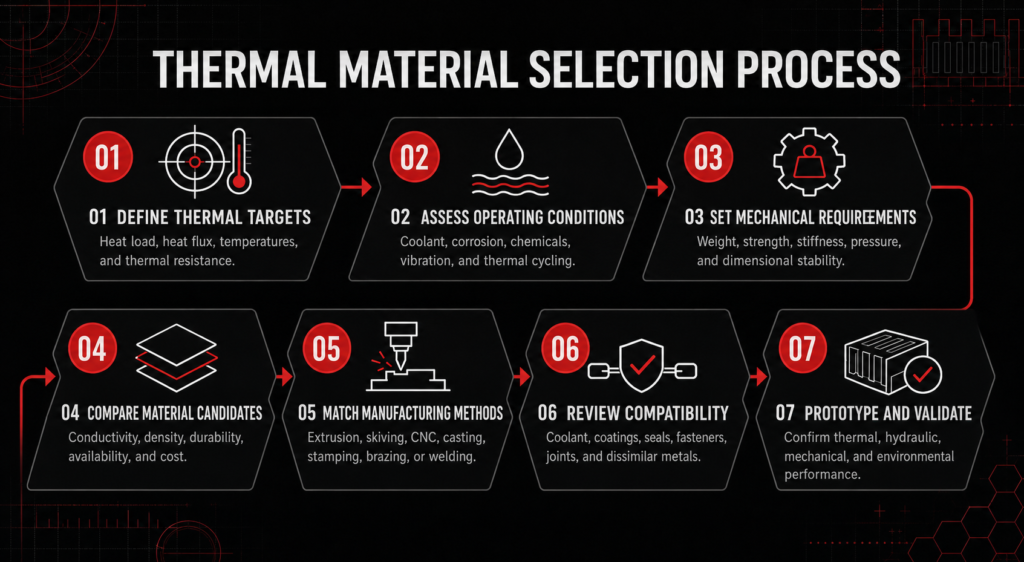
Validating the Selected Material
Datasheet properties cannot fully represent the behavior of a manufactured cooling component. Material condition, machining, joining, surface treatment, internal cleanliness, and dimensional variation can all influence actual performance.
| Design risk | Recommended validation | Main result |
|---|---|---|
| Insufficient heat transfer | Thermal resistance testing and temperature mapping | Heat-path and temperature performance |
| Uneven cooling | Surface or channel temperature mapping | Flow and temperature uniformity |
| Excessive coolant resistance | Flow and pressure-drop testing | Hydraulic performance |
| Leakage | Leak and proof-pressure testing | Sealing integrity |
| Structural failure | Burst, load, vibration, and shock testing | Mechanical safety margin |
| Joint degradation | Thermal cycling and metallurgical inspection | Joint durability |
| Internal corrosion | Coolant compatibility and corrosion testing | Fluid-loop reliability |
| External corrosion | Salt spray or application-specific exposure testing | Surface protection performance |
| Manufacturing variation | Dimensional inspection and capability analysis | Production consistency |
Validation should reflect the real operating environment. A material that performs well in a short thermal test may still fail after prolonged coolant exposure, vibration, pressure cycling, or repeated temperature changes.
In many custom cooling systems, the most effective design combines multiple materials rather than relying on a single metal throughout the assembly.
Material selection should ultimately reflect the complete heat path, component function, operating environment, manufacturing method, joint design, reliability target, production volume, and total cost.