As electronic devices become smaller and more powerful, managing heat is a growing challenge. From AI servers to electric vehicle electronics, excess heat can reduce performance, shorten component life, and affect system reliability.
Two common cooling technologies help address this issue: vapor chambers and heat pipes. Both use phase-change heat transfer to move heat away from critical components. Yet their designs, cooling capabilities, and applications differ.
So, when comparing vapor chamber vs heat pipe, which one performs better?
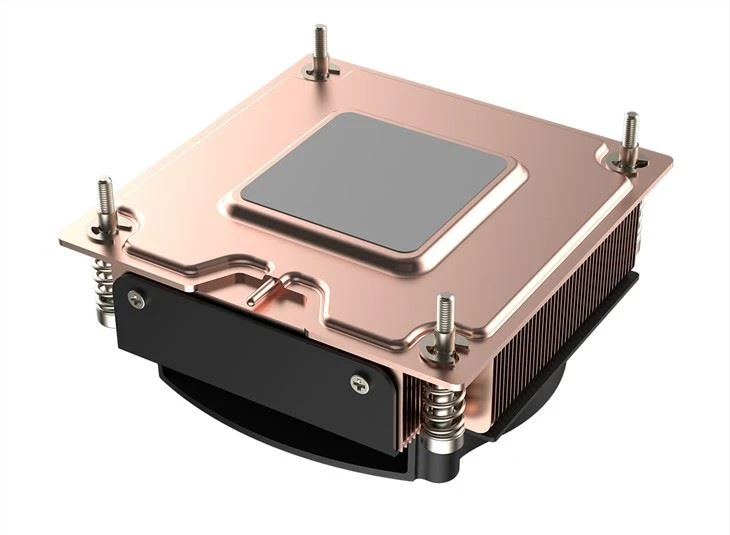
The answer isn’t as simple as choosing the newer or more advanced technology. Vapor chambers often excel at spreading heat across flat surfaces, while heat pipes are well suited to moving heat between separate locations.
Understanding these differences can help engineers select the right cooling solution for their applications.
What Is a Vapor Chamber?
A vapor chamber is a sealed, flat heat transfer device that uses liquid evaporation and condensation to spread heat across a surface.
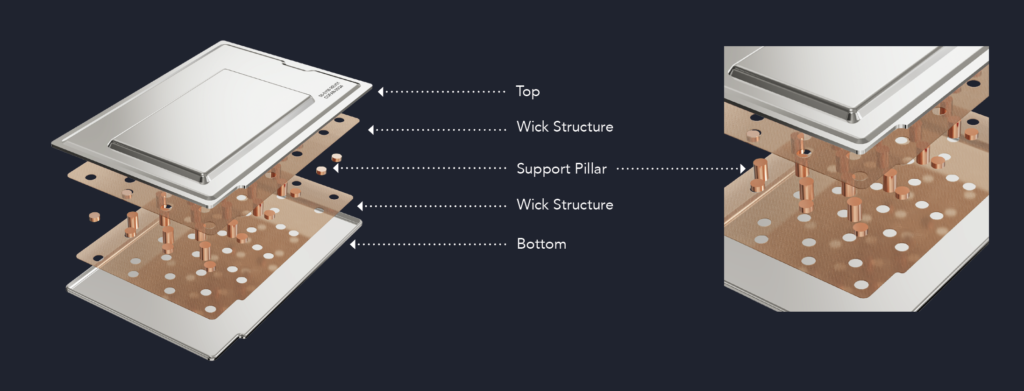
Unlike traditional solid metal heat spreaders, vapor chambers use a two-phase cooling process. This allows them to distribute heat from concentrated sources across a larger area with relatively low thermal resistance when designed for suitable operating conditions.
Vapor Chamber Structure and Components
A typical vapor chamber consists of four main components:
- Metal enclosure: Usually made from copper, it forms a sealed chamber and provides a conductive surface.
- Wick structure: A porous material that returns condensed liquid to the heated area through capillary action.
- Working fluid: Often deionized water in copper-based designs, selected according to operating temperature and material compatibility.
- Internal support structures: Features that help maintain the chamber’s shape under external pressure and mechanical loads.
These components work together to create a continuous heat transfer cycle.
How Does a Vapor Chamber Work?
When a heat source contacts the vapor chamber, the working fluid near the heated surface absorbs energy and evaporates.
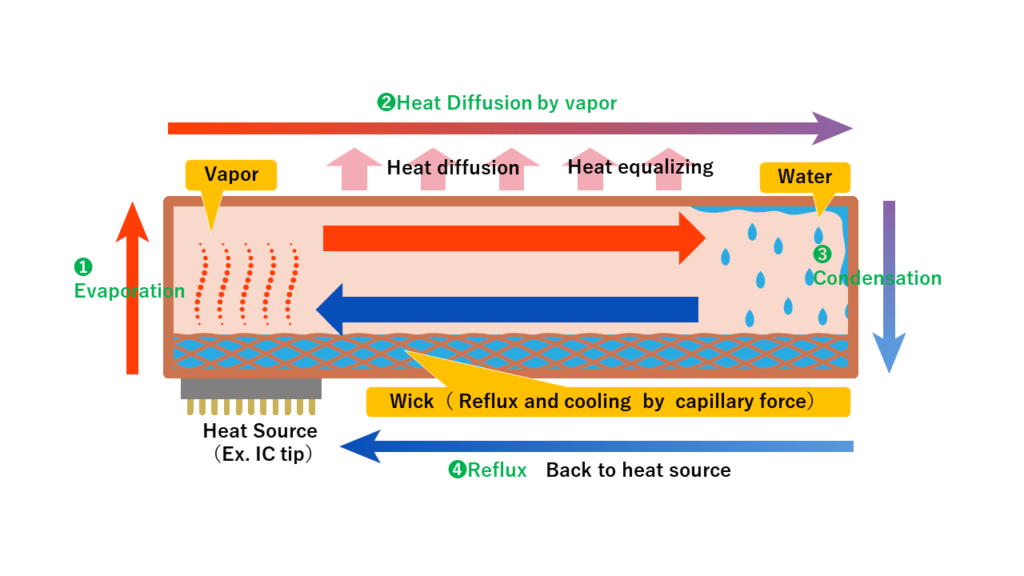
The vapor then moves toward cooler regions inside the chamber, where it condenses and releases latent heat. The wick structure draws the liquid back toward the heat source through capillary action.
This cycle repeats as long as operating conditions support it.
Because vapor can move across the chamber’s internal space, a vapor chamber can spread heat in multiple planar directions. This makes it useful for cooling large surfaces or distributing heat from concentrated electronic components.
What Is a Heat Pipe?
A heat pipe is a sealed thermal transfer device that moves heat from one location to another using the same evaporation and condensation principle.
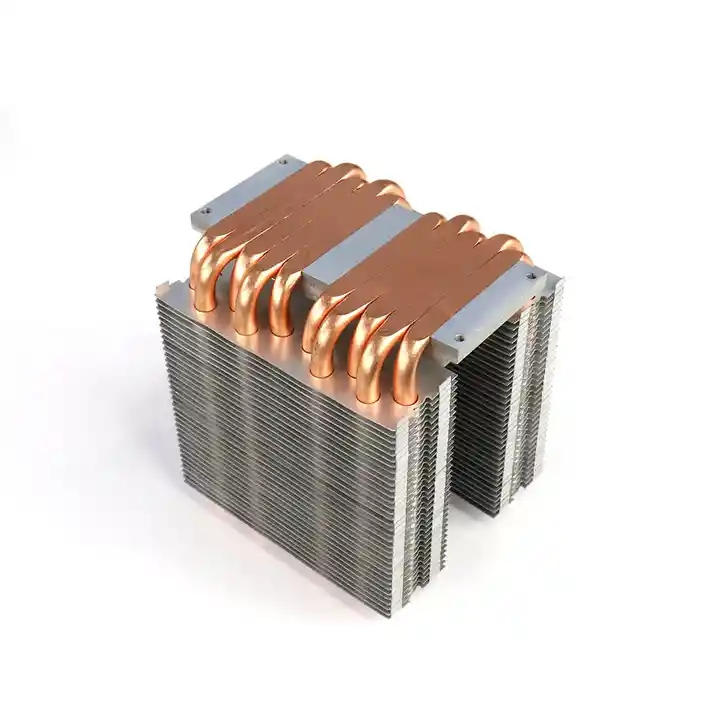
Most conventional heat pipes have a cylindrical shape, although flattened and custom-shaped designs are also available. Their main advantage is the ability to transport heat over a distance without requiring an active pumping system.
Heat Pipe Structure and Design
A typical heat pipe contains a metal tube, a working fluid, and an internal wick structure.
The tube is divided into three functional regions: the evaporator, the adiabatic section, and the condenser.
The evaporator absorbs heat from the source. The adiabatic section transports vapor between regions, while the condenser releases heat to a cooler surface.
Some heat pipes use gravity to return condensed liquid. Others rely on capillary wick structures, allowing operation across a wider range of orientations.
How Does a Heat Pipe Transfer Heat?
When the evaporator receives heat, the working fluid changes from liquid to vapor.
The resulting vapor pressure difference drives vapor toward the cooler condenser region. There, it releases heat and returns to liquid form.
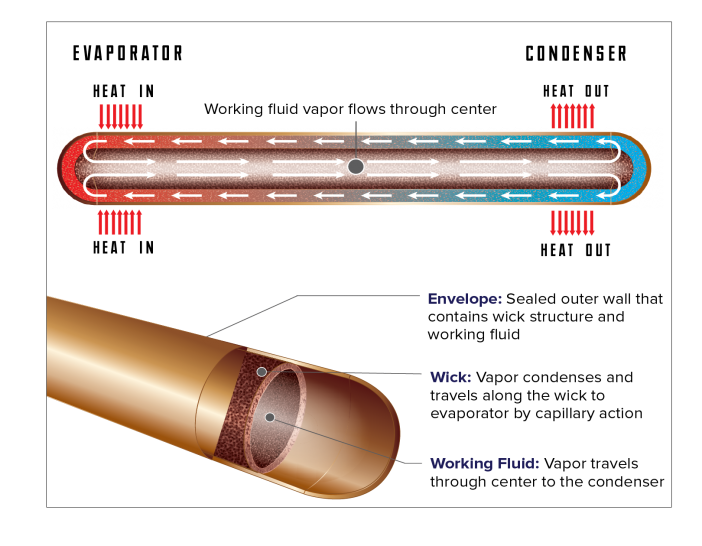
The liquid then flows back toward the evaporator through capillary action or gravity, depending on the design.
This process makes heat pipes useful for moving heat from compact electronic components to remote heat sinks.
For example, a heat pipe can transfer heat from a processor to a finned aluminum heat sink positioned where airflow is more effective.
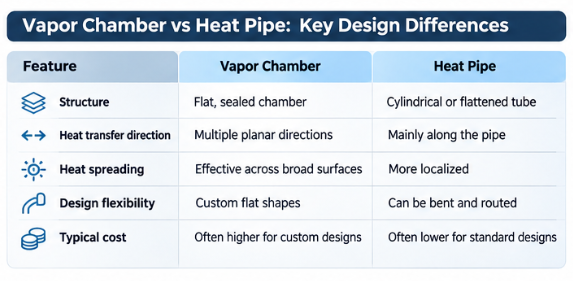
Vapor Chamber vs Heat Pipe: Key Design Differences
Although vapor chambers and heat pipes operate on similar physical principles, their geometries create different heat transfer characteristics.
A vapor chamber generally provides a broad, flat surface for heat spreading. A conventional heat pipe provides a defined path for moving heat between locations.
The following table highlights their main differences.
| Feature | Vapor Chamber | Heat Pipe |
|---|---|---|
| Typical structure | Flat, sealed chamber | Cylindrical or flattened tube |
| Heat transfer direction | Multiple planar directions | Mainly along the pipe |
| Heat spreading | Effective across broad surfaces | More localized unless multiple pipes are used |
| Design flexibility | Custom flat shapes | Can be bent and routed |
| Thickness | Suitable for low-profile assemblies | Depends on pipe diameter and flattening |
| Manufacturing complexity | Often more complex internal construction | Established tube-based processes |
| Typical cost | Often higher for custom designs | Often lower for standard designs |
| Common applications | Processors, power modules, compact electronics | Laptops, power electronics, remote heat sinks |
Neither design is automatically superior. Their performance depends on how well the thermal solution matches the heat source and surrounding cooling system.
Vapor Chamber vs Heat Pipe: Thermal Performance Comparison
Thermal performance is often the deciding factor when selecting a cooling technology.
However, comparing vapor chambers and heat pipes requires more than looking at maximum heat transfer capacity. Engineers must also consider thermal resistance, temperature uniformity, operating orientation, and system geometry.
Heat Spreading Efficiency
One of the most important differences is how each device distributes heat.
Vapor chambers are designed to spread heat across a relatively large surface. This helps distribute thermal energy from a small heat source to a larger heat sink base.
Heat pipes, by contrast, primarily transport heat along their length.
Imagine a high-power processor generating heat in a small area. A vapor chamber can spread that heat across a wider cooling surface, allowing more of the attached heat sink to participate in heat removal.
A heat pipe can also cool the processor effectively, but its performance depends on the pipe arrangement, contact area, and heat sink design.
For applications requiring broad planar heat spreading, vapor chambers often have an advantage.
Thermal Resistance
Thermal resistance measures how strongly a thermal system resists heat flow.
It is commonly expressed as:
Rth=QΔT
Where:
- Rth = Thermal resistance (°C/W or K/W)
- ΔT = Temperature difference (°C or K)
- Q = Heat transfer rate (W)
Lower thermal resistance generally means a smaller temperature difference is needed to transfer the same amount of heat.
Vapor chambers can achieve low spreading resistance when transferring heat from concentrated sources across broad surfaces.
Heat pipes can provide low thermal resistance when transporting heat between separated locations.
Still, performance depends on working fluid selection, wick structure, heat load, operating temperature, and installation conditions.
A poorly designed vapor chamber may perform worse than a well-designed heat pipe system. The geometry and operating conditions matter more than the technology name alone.
Heat Transfer Capacity
Both technologies can transfer substantial amounts of heat relative to their size.
However, their maximum heat transfer capacity is limited by physical factors, including capillary pressure, vapor flow, liquid return, and operating temperature.
In heat pipes, insufficient liquid return can cause evaporator dry-out, leading to a sharp increase in temperature.
Vapor chambers face similar operating limits, particularly when high heat flux is concentrated in a small region.
As a result, engineers should evaluate the heat load and heat flux distribution rather than assuming that a larger chamber always provides better cooling.
Temperature Uniformity
Temperature uniformity is another important consideration, especially for high-performance electronics.
Vapor chambers can reduce temperature differences across broad cooling surfaces by distributing heat in multiple directions.
This is valuable when several components generate heat within a limited area.
Heat pipes can also support uniform cooling when arranged in parallel or combined with conductive heat spreaders.
However, a single conventional heat pipe is generally less suited to distributing heat across a wide, flat surface than a vapor chamber designed for that purpose.
Advantages and Limitations of Vapor Chambers
Vapor chambers offer several benefits for compact, high-power electronics.
Their flat structure supports direct contact with processors, power modules, and other heat-generating components. Their planar heat spreading also helps distribute heat across a larger heat sink base.
Another advantage is their ability to support thin cooling assemblies where vertical space is limited.
However, vapor chambers have some limitations.
Their manufacturing process may require precise wick fabrication, internal support design, fluid charging, and hermetic sealing. Custom shapes can increase production complexity and cost.
They also have operating limits related to heat flux, orientation, mechanical loading, and working fluid properties.
Therefore, vapor chambers are most useful when their heat-spreading advantages justify the additional design and manufacturing requirements.
Advantages and Limitations of Heat Pipes
Heat pipes remain widely used because they offer effective heat transport with flexible mechanical integration.
One major benefit is their ability to move heat away from a source toward a separate cooling location.
This is especially useful when a heat sink cannot be placed directly above a processor or power component.
Heat pipes can also be bent, flattened, or arranged in groups to fit different equipment layouts.
Standard heat pipe designs may offer cost advantages compared with custom vapor chambers.
However, heat pipes are not ideal for every application.
Their tubular geometry can limit direct contact area, while excessive flattening or bending may affect internal vapor flow and liquid return.
When cooling a large surface, multiple heat pipes or an additional heat spreader may be required.
Vapor Chamber vs Heat Pipe: Applications in Modern Electronics
The choice between these technologies becomes clearer when examining real-world applications.
AI Servers and Data Centers
AI processors and high-performance computing systems generate concentrated thermal loads.
Vapor chambers can help spread heat from processor packages into larger heat sink assemblies.
Heat pipes are useful when thermal energy must be transported to cooling fins located away from the heat source.
Depending on the system layout, both technologies may be used within the same thermal management assembly.
Electric Vehicle Power Electronics
Electric vehicles contain heat-sensitive components, including power converters, control modules, and electronic systems.
Heat pipes can transfer heat between separated components and cooling structures.
Vapor chambers may be suitable for applications requiring uniform heat spreading across compact power electronics.
The choice depends on operating temperature, mechanical constraints, heat flux, and the cooling architecture.
Industrial Electronics and Power Modules
Industrial control equipment often operates under continuous thermal loads.
Heat pipes can move heat toward external heat sinks, while vapor chambers can help distribute heat from dense electronic assemblies.
Both may be integrated with aluminum heat sinks and CNC-machined thermal components to improve overall heat dissipation.
Telecommunications Equipment
Telecommunications systems often require compact cooling solutions with reliable thermal performance.
Heat pipes are useful for transporting heat within densely packed equipment.
Vapor chambers can support applications where multiple heat-generating components share a limited cooling surface.
How to Choose Between a Vapor Chamber and a Heat Pipe
Choosing the right technology starts with understanding the thermal problem.
A vapor chamber may be more suitable when the design requires heat spreading across a large, flat surface. A heat pipe may be preferable when heat must travel between separate locations.
Engineers should evaluate several factors before making a decision:
- Heat source geometry: Is heat concentrated in one small area or distributed across multiple components?
- Thermal resistance: What temperature difference is acceptable at the required heat load?
- Available space: Does the assembly require a thin profile or flexible routing?
- Operating orientation: Will gravity assist or oppose liquid return?
- Mechanical integration: How will the device connect to the heat source and heat sink?
- Cost and production requirements: Does the performance benefit justify the manufacturing complexity?
It’s also important to evaluate the complete cooling assembly.
A vapor chamber or heat pipe doesn’t remove heat from the system by itself. It transfers heat toward a cooling surface, where fins, airflow, liquid cooling, or another mechanism must carry that heat away.
For this reason, heat sink design, thermal interface materials, and airflow can significantly affect overall cooling performance.