Choosing the right thermal management solution for 5G modules is essential for maintaining stable performance, controlling component temperatures, and supporting long-term reliability. As 5G equipment handles demanding data traffic and higher power densities, heat becomes a major design challenge. Aluminum heat sinks, thermal interface materials, heat pipes, vapor chambers, and active cooling systems are among the most common solutions. However, no single cooling method works best for every application. The right approach depends on the module’s power consumption, heat distribution, operating environment, and available space.

Why Is Thermal Management Important for 5G Modules?
5G technology supports high data rates, low latency, and connections across a wide range of devices. Behind these capabilities are electronic components that consume power and generate heat.
RF amplifiers, processors, and power management circuits all contribute to thermal loads. As equipment becomes smaller and more integrated, removing this heat becomes harder.
Without adequate cooling, high operating temperatures can affect electronic performance and component reliability.
Heat Generation in 5G RF and Power Components
RF power amplifiers are significant heat sources in many 5G communication systems.
These components convert electrical power into radio-frequency signals. Because the conversion process is not perfectly efficient, some input power becomes heat.
For example, an RF amplifier operating at 40% power-added efficiency may dissipate substantial thermal energy, depending on its RF input and output power.
Other components, including baseband processors and power management integrated circuits, also generate heat during operation.
When several heat-producing components are installed close together, their combined thermal load can create localized hot spots.
How Excessive Heat Affects 5G Performance
Temperature affects semiconductor behavior.
As operating temperatures rise, RF amplifier characteristics may change, affecting gain, efficiency, and signal linearity.
Excessive heat can also trigger thermal protection mechanisms in certain processors and communication modules. These mechanisms may reduce operating performance to limit further temperature increases.
Over time, prolonged exposure to high temperatures can accelerate some electronic aging mechanisms.
Effective 5G thermal management therefore plays an important role in maintaining consistent operating conditions.
Thermal Challenges in Compact 5G Devices
Compact 5G equipment presents a difficult engineering problem: more functionality must fit into less space.
Smaller enclosures leave limited room for heat sinks, airflow channels, and other cooling components.
Outdoor equipment faces additional challenges, including solar radiation, high ambient temperatures, dust, moisture, and restricted airflow.
These conditions make thermal design a critical part of product development rather than something engineers can address after the electronics are complete.
Common Heat Sources in 5G Modules
Before selecting a cooling solution, engineers need to understand where heat originates.
Different components produce different thermal loads, and each may require a specific heat transfer path.
RF Power Amplifiers
RF power amplifiers are often among the most demanding components in 5G radio equipment.
Their heat generation depends on operating frequency, output power, efficiency, and signal characteristics.
High-power amplifiers may require direct thermal contact with a metal baseplate or heat sink to transfer heat away from the semiconductor package.
Baseband Processors and Modems
Baseband processors handle digital signal processing, data transmission, and communication protocols.
Their thermal output varies with processing activity and system architecture.
In compact 5G routers and communication modules, processors may share a cooling structure with other electronic components.
This makes temperature distribution and mechanical contact important design considerations.
Power Management Integrated Circuits
Power management ICs regulate and distribute electrical power throughout the system.
Although individual components may dissipate less heat than RF amplifiers, they can still create localized hot spots.
Their placement near other heat-sensitive components can make thermal control more challenging.
Thermal Management Solutions for 5G Modules
There are several ways to remove heat from 5G electronics. Each technology serves a different purpose, and many systems combine multiple cooling methods.
The most suitable thermal management solution for 5G modules depends on how heat moves from the electronic components to the surrounding environment.
Aluminum Heat Sinks
Aluminum heat sinks are widely used in electronic cooling because they combine good thermal conductivity, relatively low weight, and practical manufacturing characteristics.
They absorb heat from electronic components and transfer it to the surrounding air through conduction, convection, and radiation.
Their fins increase the surface area available for heat exchange.
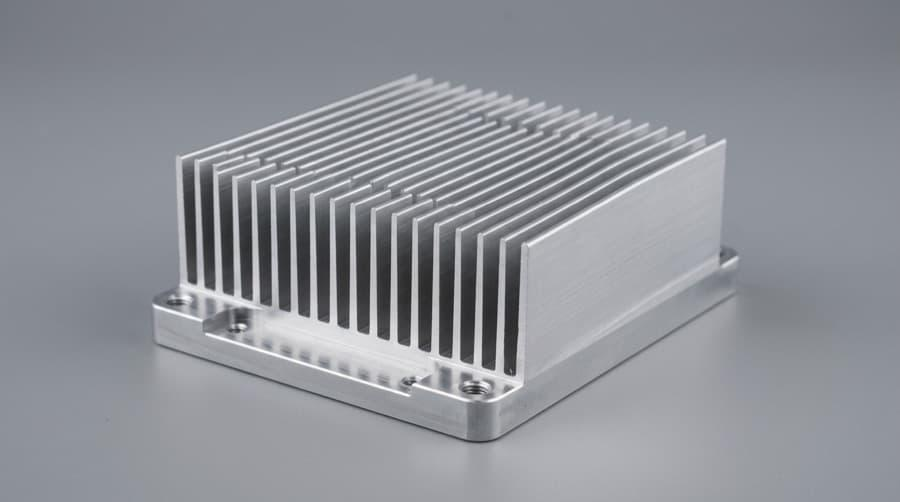
Extruded aluminum heat sinks are especially useful when the design requires a consistent cross-sectional profile with multiple cooling fins.
For more complex assemblies, CNC machining can add mounting holes, contact surfaces, and other mechanical features.
An aluminum heat sink for 5G equipment may be suitable for RF modules, small cells, communication enclosures, and industrial networking devices.
However, its performance depends on fin geometry, airflow, thermal contact, and operating conditions.
Thermal Interface Materials (TIMs)
Even carefully machined metal surfaces contain microscopic gaps.
When a heat sink contacts an electronic component, these gaps can increase thermal resistance.
Thermal interface materials help fill the spaces between mating surfaces, improving heat transfer across the interface.
Common TIMs include thermal grease, thermal pads, phase-change materials, and thermally conductive gap fillers.
The right material depends on contact pressure, surface flatness, gap thickness, electrical insulation requirements, and operating temperature.
For example, a compressible thermal pad may be useful when a 5G module has components of different heights.
A thin layer of thermal grease may be more suitable for a tightly controlled metal-to-metal interface.
Heat Pipes and Vapor Chambers
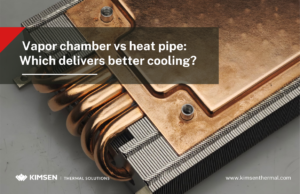
Heat pipes and vapor chambers use phase-change heat transfer to move thermal energy.
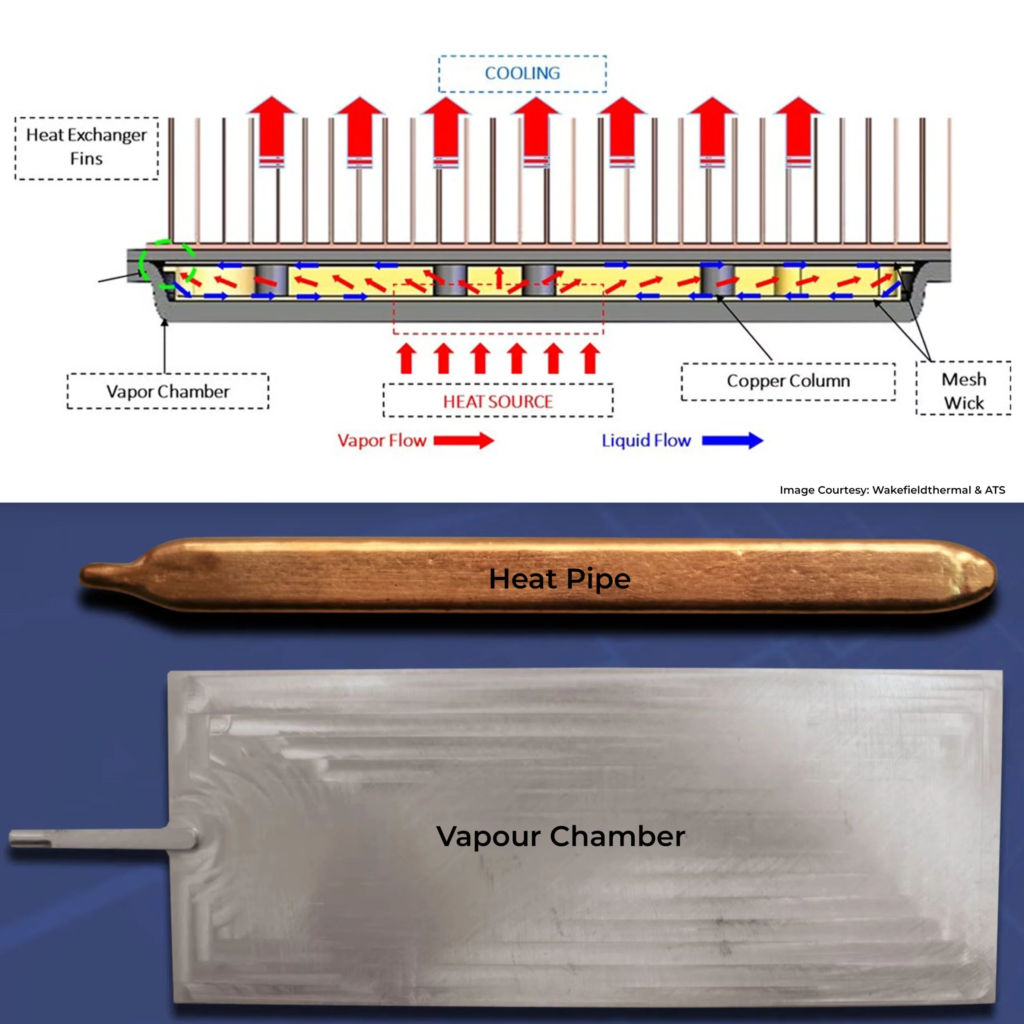
Both contain a working fluid that evaporates near a heat source and condenses in a cooler region.
The main difference is how they distribute heat.
Heat pipes are useful when heat must travel from a component to a cooling surface located some distance away.
Vapor chambers are generally better suited to spreading heat across a broad, flat area.
In compact 5G equipment, these technologies may help transfer heat toward a larger heat sink or enclosure surface.
However, they add design and manufacturing complexity, so their benefits should be evaluated against the thermal requirements.
Active Cooling with Fans
Passive cooling relies on natural heat transfer without powered airflow.
Active cooling adds fans or blowers to move air across heat sinks and electronic components.
Forced airflow can increase convective heat transfer, allowing a heat sink to dissipate more heat under suitable conditions.
This approach can be useful in high-performance 5G routers, network equipment, and enclosed communication systems.
However, fans consume electrical power and introduce moving parts.
They may also require maintenance, especially in dusty environments.
For outdoor telecommunications equipment, designers must consider fan reliability, acoustic noise, environmental protection, and maintenance access.
Liquid Cooling for High-Power 5G Equipment
Liquid cooling uses a circulating coolant to carry heat away from electronic components.
Because liquids can transport significant thermal energy, liquid cooling may be considered for high-power systems with concentrated heat loads.
A typical system includes a cold plate, pump, coolant channels, and a heat exchanger.
However, liquid cooling also introduces additional components, sealing requirements, and maintenance considerations.
It is generally more relevant to specialized high-power equipment than to small, low-power 5G modules.
Choosing the Right Materials for 5G Thermal Management
Material selection affects thermal performance, equipment weight, corrosion resistance, and manufacturing cost.
Aluminum and copper are two common metals used in electronic cooling systems.
Aluminum vs Copper for Heat Dissipation
Copper has higher thermal conductivity than aluminum.
At room temperature, pure copper has a thermal conductivity of approximately 400 W/m·K, while pure aluminum is around 235 W/m·K. Actual values vary by alloy and material condition.
This makes copper useful for components that require strong heat spreading near concentrated heat sources.
However, copper is considerably heavier and often more expensive.
Aluminum offers a useful balance between thermal conductivity, weight, cost, and manufacturing flexibility.
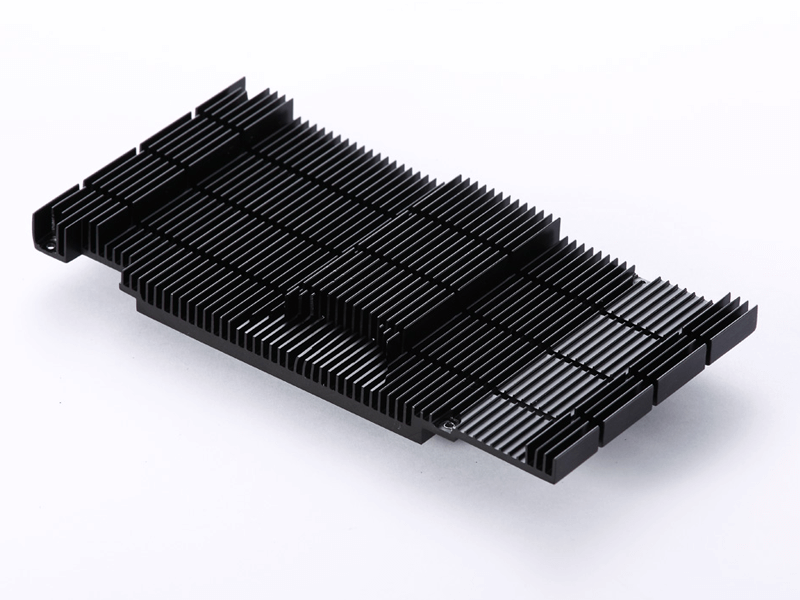
For many telecommunications applications, aluminum heat sinks provide an effective cooling solution without the additional weight of an all-copper structure.
Thermal Conductivity and Weight Considerations
Thermal conductivity is important, but it doesn’t determine cooling performance by itself.
A well-designed aluminum heat sink may outperform a poorly designed copper heat sink when airflow, surface area, and thermal contact are considered.
Weight also matters.
Outdoor 5G equipment may be installed on poles, towers, walls, or other structures where additional mass affects mechanical design.
Aluminum’s lower density makes it attractive for large heat sinks and equipment housings.
Surface Treatments and Corrosion Resistance
Outdoor telecommunications equipment must withstand changing weather conditions.
Aluminum naturally forms a protective oxide layer, but additional surface treatments may be useful in demanding environments.
Anodizing can improve surface corrosion resistance and change surface emissivity.
However, anodized coatings may also affect electrical contact and thermal interfaces.
Engineers should therefore consider both environmental protection and thermal performance when specifying surface finishes.
Key Design Factors for Effective 5G Module Cooling
Selecting cooling components is only part of the process.
An effective 5G thermal design must account for how heat moves through the complete assembly.
Power Density and Heat Flux
Power density describes how much power is dissipated within a given volume or area.
Heat flux describes the heat transfer rate per unit area.
When a small component generates substantial heat, the resulting heat flux can create a concentrated thermal challenge.
Engineers may use copper spreaders, vapor chambers, or carefully designed heat sink bases to distribute heat across a larger surface.
Airflow and Heat Sink Geometry
Heat sink performance depends heavily on airflow.
Fin height, thickness, spacing, and orientation influence how air moves through the cooling structure.
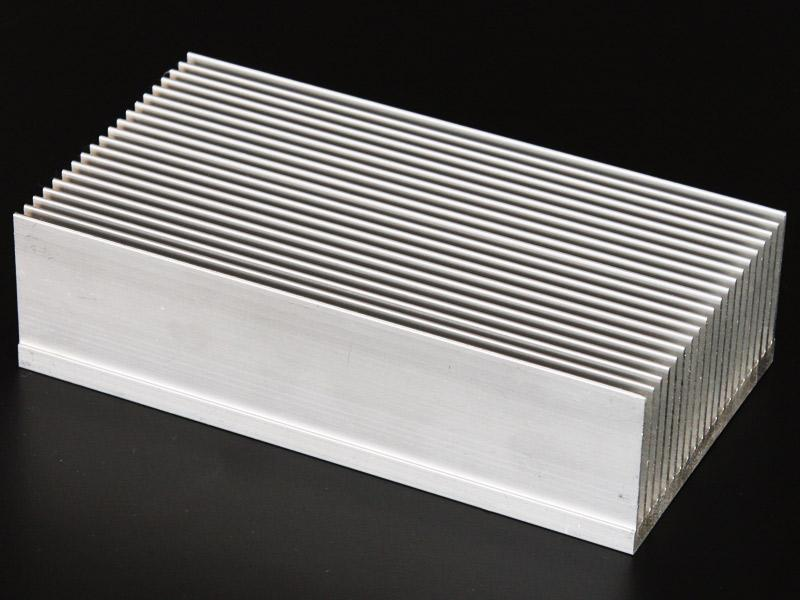
For natural convection, fin orientation and spacing must allow warm air to rise.
For forced convection, designers must consider fan characteristics and pressure losses through the fin channels.
Adding more fins does not always improve cooling. If spacing becomes too narrow, airflow resistance may increase and reduce overall performance.
Thermal Resistance and Contact Quality
Thermal resistance describes the temperature difference required to transfer a given amount of heat.
It is commonly expressed as:
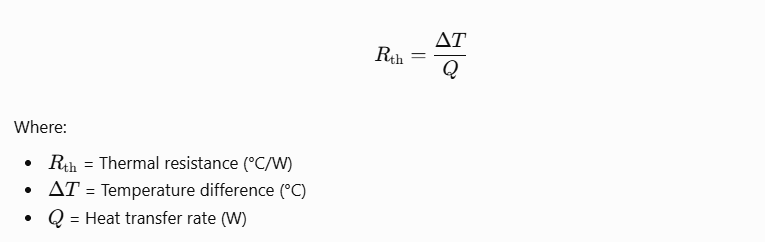
Lower thermal resistance generally indicates more effective heat transfer under comparable conditions.
Contact pressure, surface flatness, TIM thickness, and mounting design can all influence thermal resistance.
Environmental and Operating Conditions
A cooling solution that performs well in a laboratory may behave differently outdoors.
Ambient temperature, solar exposure, altitude, dust, and enclosure design can affect heat dissipation.
For outdoor 5G modules, engineers should evaluate the complete operating temperature range rather than relying only on room-temperature testing.
Thermal Management Applications Across 5G Equipment
Different 5G applications require different cooling strategies.
| Application | Main thermal challenge | Common cooling approaches |
|---|---|---|
| 5G small cells | Compact enclosure, RF heat loads | Aluminum heat sinks, conductive enclosures, TIMs |
| Massive MIMO antenna systems | Multiple RF power amplifiers, distributed heat | Large heat sinks, thermal spreaders, enclosure cooling |
| 5G routers and CPE | Limited space, variable workloads | Heat spreaders, thermal pads, passive or fan cooling |
| Industrial 5G IoT devices | Sealed housings, harsh environments | Conductive housings, aluminum heat sinks, thermal pads |
5G Small Cells
Small cells provide wireless coverage in localized areas.
Their compact size often limits cooling space, while outdoor installations may restrict the use of moving parts.
Passive aluminum heat sinks and thermally conductive housings are common approaches for transferring heat to the surrounding air.
Massive MIMO Antenna Systems
Massive MIMO systems use multiple antenna elements and RF signal paths.
Their thermal requirements depend on the number of active channels, power amplifier efficiency, and operating conditions.
Large heat sinks and thermally conductive structures can help distribute and dissipate heat from these assemblies.
5G Routers and Customer Premises Equipment
5G routers and customer premises equipment are often designed for compact indoor installation.
These devices may use thermal pads, metal spreaders, and small heat sinks to transfer heat from processors and RF components.
Some higher-power designs also use fans to improve airflow.
Industrial 5G IoT Devices
Industrial 5G devices may operate in factories, transportation systems, or outdoor environments.
Dust, moisture, vibration, and limited maintenance access can influence cooling system selection.
Sealed metal housings and passive heat dissipation may be suitable when the thermal load and environmental conditions allow.
How to Evaluate 5G Thermal Management Performance
Cooling solutions should be assessed through engineering analysis and physical testing.
Thermal Simulation and CFD Analysis
Computational fluid dynamics (CFD) and thermal simulation tools help engineers estimate temperature distribution and airflow behavior.
Tools such as Ansys Icepak and Siemens Simcenter FLOEFD can support electronics cooling analysis.
Simulation can help identify potential hot spots, compare heat sink geometries, and evaluate airflow paths before physical prototypes are produced.
However, simulation results depend on the accuracy of the material properties, boundary conditions, and heat load assumptions.
Temperature Measurement and Testing
Physical testing is necessary to confirm thermal performance.
Common measurement methods include thermocouples, resistance temperature detectors, and infrared thermography.
Engineers should evaluate temperatures under representative workloads and environmental conditions.
Testing should also account for sensor placement and measurement uncertainty.
Reliability and Long-Term Performance
Thermal performance should remain acceptable throughout the intended operating life of the equipment.
Thermal cycling, high-temperature operation, vibration, and environmental exposure may affect cooling components and interfaces.
For example, some thermal interface materials can change over time due to mechanical movement or repeated temperature cycles.
Reliability testing helps engineers understand how the cooling system behaves under expected service conditions.